
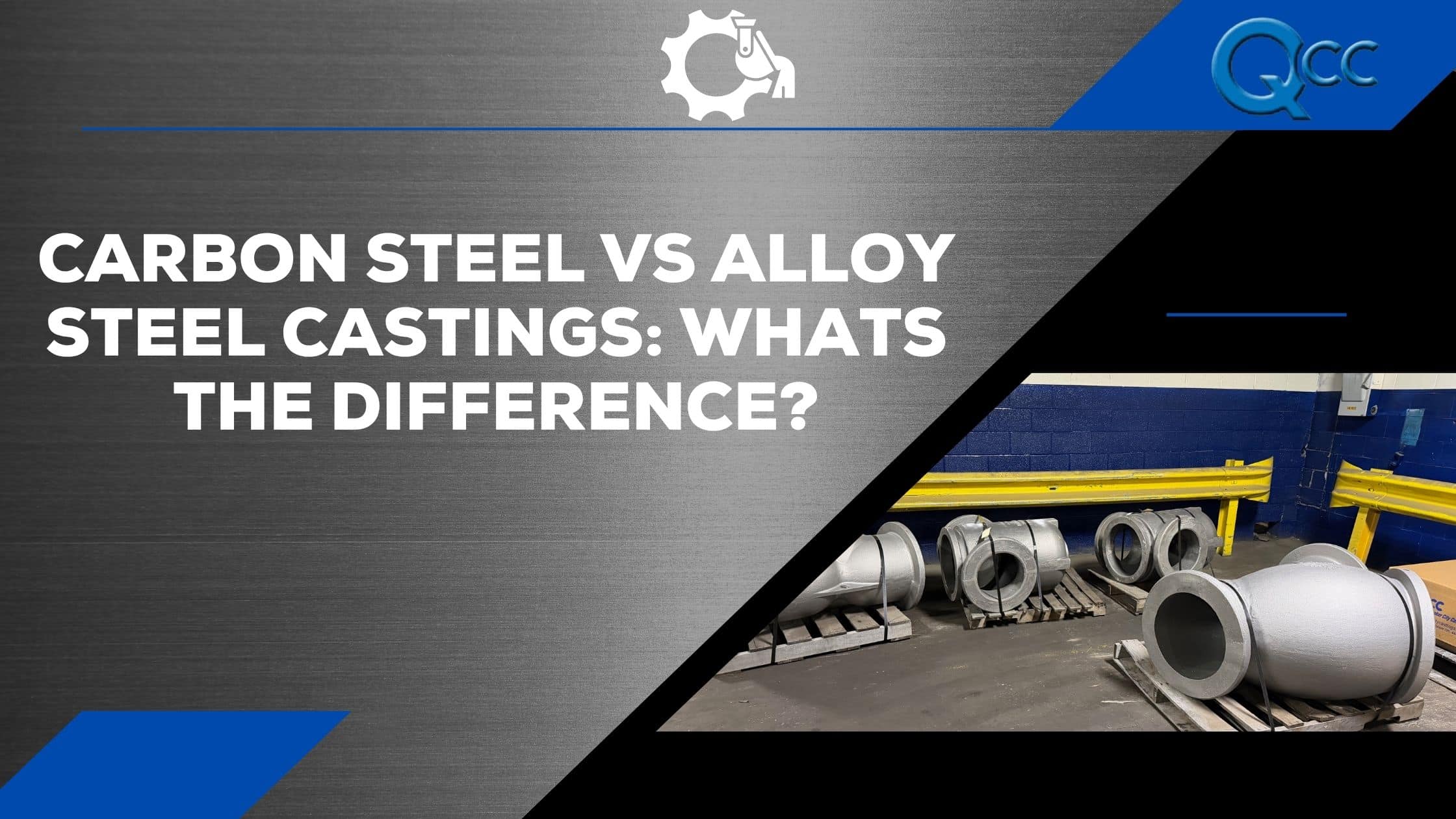
Selecting the right material is one of the most important decisions in any metal casting project. The steel grade used in a component directly affects strength, toughness, wear resistance, machinability, corrosion performance, and long-term reliability. Two of the most common options used in industrial foundries are carbon steel castings and alloy steel castings.
While both materials are steel-based and widely used across heavy industry, they are not interchangeable. Each offers unique benefits depending on the operating environment and performance requirements of the final component.
At Quaker City Castings, we produce a wide range of carbon steel and alloy steel castings for demanding applications in energy, infrastructure, transportation, defense, pump and valve systems, and heavy equipment. In this blog, we explain the key differences between carbon steel and alloy steel castings and how to determine which option may be right for your project.
Understanding Carbon Steel Castings
Carbon steel is one of the most commonly used engineering materials in manufacturing. It is primarily composed of iron and carbon, with relatively small amounts of manganese, silicon, and residual elements. In carbon steel castings, the level of carbon plays a major role in determining strength, hardness, and ductility.
Low-carbon grades are typically easier to machine and weld, while medium- and higher-carbon grades often provide improved strength and wear resistance. Because of their balance between cost and performance, carbon steel castings are used in a wide variety of industrial applications.
Many structural components, housings, valve bodies, brackets, and pressure-containing parts are produced from carbon steel because it offers dependable mechanical performance without the added cost of specialty alloying elements.
Carbon steel castings can also be heat treated to improve tensile strength, toughness, and hardness, making them even more versatile for industrial service.
Understanding Alloy Steel Castings
Alloy steel castings contain additional elements beyond carbon steel’s standard composition. These may include chromium, molybdenum, nickel, manganese, vanadium, or other alloying additions used to enhance specific properties.
By carefully controlling chemistry and heat treatment, alloy steel castings can be engineered for higher strength, improved wear resistance, better toughness, elevated temperature service, or increased corrosion resistance compared to standard carbon steel grades.
This makes alloy steel castings a preferred choice in more demanding environments where standard carbon steel may not deliver the required lifespan or mechanical performance.
Applications such as mining equipment, power generation systems, high-pressure fluid systems, and defense hardware often rely on alloy steel castings because of their ability to perform under extreme loads, abrasive wear, or thermal stress.
The Main Difference Between Carbon Steel and Alloy Steel Castings
The primary difference comes down to chemistry and performance customization.
Carbon steel castings rely mainly on carbon content and heat treatment to achieve desired properties. They are cost-effective, dependable, and suitable for many general industrial uses.
Alloy steel castings use additional alloying elements to significantly improve specific characteristics. This allows engineers to tailor the material to more challenging applications.
In simple terms, carbon steel is often the economical all-purpose option, while alloy steel is the performance-focused solution when service conditions become more severe.
Strength and Mechanical Performance
Both carbon steel and alloy steel castings can provide excellent strength, but alloy steels often have the advantage in high-demand applications.
Carbon steel castings offer strong baseline mechanical properties and are commonly used where loads are moderate to heavy but not extreme. With proper heat treatment, carbon steel can perform very well in structural and pressure-related uses.
Alloy steel castings, however, are frequently selected when higher tensile strength, improved fatigue resistance, or better impact toughness is required. Alloying elements refine the steel’s response to heat treatment and can improve mechanical consistency throughout the casting.
This is especially important in industries where components are exposed to repeated stress cycles or shock loading.
Wear Resistance and Tough Conditions
Wear is a major factor in industries such as mining, aggregate processing, material handling, and heavy construction.
Carbon steel castings can perform well in moderate wear environments, especially when properly heat treated. However, alloy steel castings often provide superior abrasion resistance due to their enhanced hardness and microstructure.
When parts are exposed to sliding wear, impact wear, or harsh contact conditions, alloy steel may significantly extend service life and reduce replacement frequency.
That longer lifespan can offset the higher upfront material cost.
Corrosion and Heat Resistance
Standard carbon steel castings generally require coatings, paint systems, or controlled environments to resist corrosion. While they perform very well in many dry or managed industrial settings, they are not typically the first choice for aggressive chemical or high-moisture environments.
Certain alloy steel castings offer improved resistance to oxidation, scaling, and elevated temperatures. Depending on the chemistry, alloy steels may also provide better corrosion performance than basic carbon steel grades.
For power generation, refinery, and high-temperature process systems, alloy steel castings are often selected because they maintain strength more effectively at elevated temperatures.
Machinability and Fabrication
Carbon steel castings are often easier to machine than some higher-strength alloy steels, especially in normalized or annealed conditions. This can reduce machining time, tooling wear, and production cost.
Alloy steel castings may require more robust machining strategies depending on hardness and composition. However, the tradeoff is often worthwhile when higher performance is required in the field.
Weldability can also vary. Many carbon steel grades are relatively weld-friendly, while certain alloy steels may require preheat, post-weld heat treatment, or tighter fabrication controls.
Working with an experienced foundry helps ensure these factors are considered early in the project.
Cost Considerations
Cost is always part of material selection.
Carbon steel castings are generally more economical because they use fewer expensive alloying elements and may be easier to machine or process.
Alloy steel castings usually carry a higher material and processing cost. However, the real comparison should be based on total lifecycle value, not just purchase price.
If alloy steel lasts longer, performs better, reduces downtime, or lowers maintenance frequency, it may be the more economical solution over time.
This is particularly true in critical operations where equipment failure is extremely costly.
Common Applications for Carbon Steel Castings
Carbon steel castings are commonly used in:
Structural components, industrial housings, brackets, valve bodies, pump casings, pressure-retaining parts, transportation hardware, and general-purpose machinery components.
They are ideal where dependable strength and cost efficiency are priorities.
Common Applications for Alloy Steel Castings
Alloy steel castings are frequently used in:
Mining components, high-pressure systems, wear parts, turbine components, heavy-duty gears, defense hardware, elevated-temperature equipment, and demanding fluid control systems.
They are often selected where standard carbon steel would have a shorter service life.
Why Work with Quaker City Castings
At Quaker City Castings, we help customers choose the right material for performance, manufacturability, and cost efficiency. Our team works with a broad range of castable steel grades and provides guidance based on real-world service demands.
With advanced no-bake sand casting, in-house heat treatment, machining capabilities, and rigorous quality control, we deliver castings built for demanding industrial applications.
Whether your project calls for carbon steel castings or alloy steel castings, we can help develop the right solution.
Final Thoughts
Understanding the difference between carbon steel and alloy steel castings is essential for making the right engineering and purchasing decision.
Carbon steel castings provide dependable performance and cost-effective versatility for many industrial uses. Alloy steel castings offer enhanced strength, wear resistance, toughness, and specialized performance when conditions become more demanding.
The right choice depends on the application, environment, and long-term value required.
If you are evaluating materials for an upcoming project, contact Quaker City Castings to discuss the best casting solution for your needs.
Leave A Comment